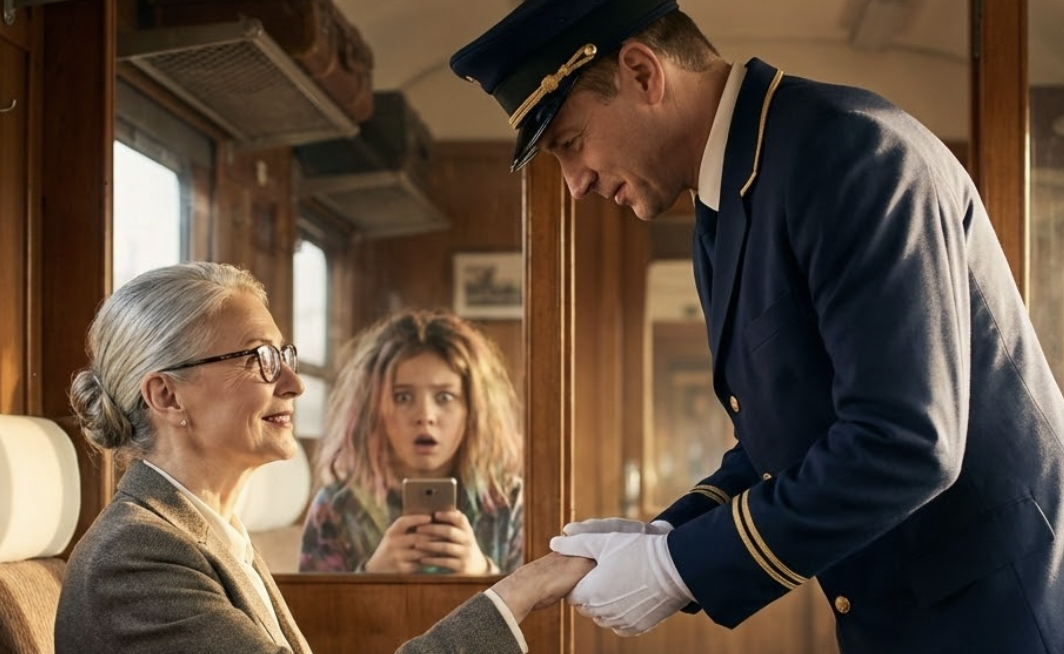
In the compartment, a girl tossed my things off the lower bunk: “Old people belong by the toilet!” Then the train chief walked in and kissed my hand.
The car jerked, clanged with metal, and stopped, like a tired animal reaching a watering hole.
Irina Sergeyevna felt the inertia tug her forward, making her grip the handle of her suitcase tighter. The vibration of the floor traveling up through the soles of her comfortable shoes finally died away, replaced by the steady hum of the air conditioner.
She adjusted her glasses, exhaled, and with effort slid the heavy compartment door aside.
Instead of the coolness and emptiness she’d counted on when buying her ticket forty-five days in advance, a wave of damp stuffiness hit her.
The space wasn’t just occupied—it had been seized with total, shameless insolence.
On her rightful lower bunk, made up with the standard-issue linens, stood a mountain of colorful pillows, bags from brand-name stores, and boxes of food.
Amid the chaos, sprawled comfortably with her feet braced against the wall, lay a young woman.
She was completely absorbed in her smartphone, her face lit by the cold bluish glow of the screen.
Irina Sergeyevna carefully rolled her suitcase inside, trying not to touch the shoes scattered around—bulky sneakers on an enormous platform.
She stopped in the narrow aisle, waiting for the girl to notice her presence.
But the girl kept swiping at the screen, ignoring reality entirely.
“Good evening,” Irina said in her lecturer’s voice—the one that usually silenced a hall of two hundred students. “Excuse me, but you’re in my place.”
The girl slowly, as if reluctantly, pulled one wireless earbud out.
She looked up at Irina with a mix of boredom and mild contempt for any living being over twenty-five.
“Huh?” she drawled lazily, not changing her pose.
“My ticket is for seat nine. That’s the lower bunk. Yours, as I understand it, is the upper.”
Irina spoke calmly but firmly, the way she did during exams when a student tried to pass wishful thinking off as fact.
The girl snorted, looked Irina up and down appraisingly, and demonstratively put the earbud back.
“I’m not climbing up there,” she tossed out, burying her face back in the phone. “The aura up there is bad. And anyway, I’m a blogger—I need an outlet.”
“There are USB ports up top,” Irina shot back, feeling the string of her patience begin to tighten inside. “And the outlet is shared.”
The girl—she couldn’t have been more than twenty-two—sat up sharply, tossing her phone onto the rumpled sheet.
Her plumped lips twisted into a grimace that was probably meant to look like righteous indignation.
She kicked Irina’s suitcase, pushing it toward the door.
“Listen, woman, you didn’t get it? I said—I’m staying here. It’s comfortable for me.”
“Comfort is subjective. A ticket is a legal document,” Irina Sergeyevna remarked, straightening her blazer.
“Oh, spare me the lecturing!” the girl rolled her eyes. “You’re old—you don’t care where you sleep. I’ve got content to make.”
Irina froze.
She was used to different flavors of youthful maximalism, but this was something else.
It wasn’t just rudeness. It was a sincere belief that the world was obligated to bend to her desires.
“And besides,” the girl continued, seeing her opponent wasn’t backing down, “go to the corridor if you don’t like it. Or climb up there yourself. Old people belong by the toilet! The air there is ‘healing,’ they say—nice draft, good ventilation. This is my territory.”
Irina Sergeyevna slowly took off her glasses and began wiping them with a handkerchief.
That line sounded like a declaration of war.
Not a loud war with shouting and broken dishes, but a cold, positional war of attrition.
She sat down on the edge of the opposite bunk, which—thankfully—was still free for now.
“What’s your name?” she asked, unexpectedly gently.
The girl tensed, but answered with defiance:
“Milana. So what—running to the police to complain?”
“No, Milana. I just want to know how to address someone who so boldly ignores the laws of physics and shared living.”
Milana snorted and pulled a bag of chips from one of her shopping bags.
She tore the package open so hard that greasy crumbs sprayed through the compartment, settling on the floor and on Irina’s clothes.
“Don’t get smart. I’ll record a story right now and say you harassed me. You’ll get hate so bad you won’t leave your house.”
She lifted her phone and clipped on a little ring light, blinding Irina with harsh LED glare.
“Hi, my kittens!” Milana’s voice changed instantly, turning syrup-sweet. “This is such trash! Some crazy granny is busting into my compartment and trying to throw a sick girl into a draft!”
She swung the camera toward Irina, who sat perfectly straight, maintaining absolute composure.
“Put the camera away,” Irina demanded dryly. “You’re violating my right to privacy.”
“You can film in a public place!” the blogger squealed happily. “Look how angry she is! She’s threatening me! I’m scared to ride with her!”
Irina Sergeyevna watched the performance and analyzed the situation like an engineering problem.
What stood before her was a structure without an internal frame.
All the bravado, the inflated lips, the threats—just a cheap facade, hiding emptiness and fear.
Any system built on lies and pressure inevitably collapses under its own weight.
You only have to find the point where force should be applied.
Milana kept mugging for the camera, chewing chips and dropping crumbs right onto the pillow where Irina was supposed to sleep.
“I’m calling the train chief!” the girl threatened, ending the recording. “I’ll say you insulted me. My followers are power. They’ll tear Russian Railways apart over how VIP clients are treated.”
She pressed the call button hard.
Irina stayed silent.
She knew that making excuses meant losing.
In strength of materials there’s a concept called “yield point”—the moment when a material stops resisting stress and begins to deform irreversibly.
Milana clearly assumed Irina’s yield point had already been reached.
But she’d miscalculated.
The compartment door didn’t slide open at once.
First came heavy footsteps, then a polite knock, and only then did a figure in uniform appear in the doorway.
The train chief looked exhausted.
His jacket fit perfectly, but deep shadows sat in the corners of his eyes—the face of a man who hadn’t slept for two days.
“What’s going on here?” he asked in a dull, professionally impassive voice. “Why are you pressing the emergency button? That’s for urgent cases.”
Milana transformed instantly.
The chips flew into a corner, her lips trembled, and tears sparkled in her eyes—as if on cue.
“Oh, help!” she whined, clutching her chest. “This woman… she’s not normal! She’s trying to throw me out!”
The train chief shifted his heavy gaze from Irina to the scattered mess.
“Tickets. Show me.”
“I’m explaining it to her!” Milana cut in before Irina could say a word. “I’m pregnant! I have a certificate… forgot it at home! I can’t jump up there, I have uterine tone! And she’s screaming, swearing, throwing things!”
Irina Sergeyevna slowly took a printed form from her purse.
Without getting up, she held it out to the man.
“Seat nine, lower bunk. Here’s my passport.”
The train chief took the paper, looked at it, then looked back at Irina.
His brows drew together slightly.
He seemed to be trying to reconcile the image of this intelligent woman in glasses with the portrait of a hysterical troublemaker Milana had painted.
“Citizen,” he addressed Irina, peering at her face. “Your surname… Vetrova?”
“Vetrova, Irina Sergeyevna,” she nodded. “Associate professor, Department of Strength of Materials.”
The man froze.
The paper trembled in his hand.
The fatigue vanished from his face as if erased, replaced by sheer astonishment mixed with childlike delight.
“Irina Sergeyevna?” he repeated, stepping forward and ignoring the pile of trash at his feet. “You?! No way!”
He squinted, studying her features—and suddenly broke into a huge grin.
“Kornilov! Seryozha Kornilov! Class of 2005! Remember me? I defended my term paper on beams three times with you!”
Irina adjusted her glasses, looking at the train chief closely.
A lecture hall rose in her memory—the smell of chalk, and a shaggy-haired student who, with stubbornness worthy of a better cause, tried to prove that a bending-moment diagram could have a discontinuity without an external load.
“Kornilov…” she drew out, and the corners of her lips twitched. “The one who confused Young’s modulus with shear modulus on the state exam?”
“That’s me!” the chief bellowed happily, as if he’d been awarded a medal. “You gave me a ‘C’ back then—took pity on me! You said, ‘Go on, Kornilov—railways will fix you.’”
“And did it?” Irina nodded at his epaulettes.
“Yes, ma’am!” he snapped to attention. “Thanks to your science, I became a person, you might say. Learned that without calculations, everything collapses. What brings you here? Why aren’t you in first-class?”
Milana, watching with her mouth hanging open, felt the plot drifting away from her script.
“Hey!” she piped up, trying to pull the focus back. “Chief! You know each other? She insulted me! Throw her out! I’ll file a complaint!”
Kornilov slowly turned his head toward Milana.
The smile disappeared instantly, as if someone turned off the lights.
Now it wasn’t a former student looking at her, but the stern master of the train, responsible for order in his domain.
“Your ticket, citizen,” he said in an icy tone.
“It’s on my phone…” Milana mumbled, feeling her confidence leak out of her like water from a holey bucket.
He didn’t even take the phone she held out.
“I can see the system. Seat ten. Upper bunk.”
“But I… I feel sick! I arranged it!”
“You didn’t arrange anything—you occupied someone else’s place,” Kornilov cut her off. “And you’ve created unsanitary conditions.”
With disgust, he nudged an empty energy drink can with the toe of his boot.
“Damage to Russian Railways property. The linens are smeared with crumbs and grease. You’ll have to pay for a set.”
“But I… I have a blog!” Milana made one last attempt. “I’ll write about you!”
“Write,” Kornilov nodded indifferently. “But first you’ll pick up your things, clean up your trash, and clear the bunk for an honored passenger.”
“I’m not cleaning!”
“Then I call transport police at the next station. We’ll file a report for petty hooliganism and violating travel rules. You’ll be put off the train.”
“Where?” Milana squeaked.
“At the station called ‘Dno.’ Symbolic, don’t you think?”
Irina Sergeyevna watched as the girl—red with anger and humiliation—began frantically scooping up her bags.
No pregnancy. No “tone.”
Only fear of real power and authority.
She grunted as she heaved heavy bags up to the top bunk, shooting Irina vicious looks.
“Seryozha… Sergey Ivanovich,” Irina said softly. “No need to be so harsh. Young people these days… they’re fragile.”
“With them there’s no other way, Irina Sergeyevna,” Kornilov sighed, turning back into a respectful pupil. “They’ll climb on your neck—you’ll never shake them off. By the way! I have a free compartment in the staff car. First-class. Quiet. No one bothers you.”
“I’m fine here…”
“You’re offending me!” he threw up his hands. “My professor traveling like this? I beg you! Come. Tea, coffee, luxury linens—we’ll arrange everything. Free of charge, as my personal guest.”
He picked up her little suitcase as easily as if it were a feather.
“Come on. I’ll also show you our new coupling system—we implemented an improvement proposal. We need your opinion—desperately!”
Irina Sergeyevna stood.
She glanced at the upper bunk, where the defeated “queen of TikTok” sat with her legs tucked up and lips puffed out.
Milana looked pitiful in her nest of belongings, right under the air-conditioning vent.
“All the best, Milana,” Irina said politely. “And a piece of advice for the future: study Newton’s third law.”
“What law now?” the girl grumbled, wrapping herself in a blanket.
“For every action, there is an equal and opposite reaction. The harder you push, the more painful the blowback.”
Irina stepped into the corridor after the beaming train chief.
The compartment door slid shut with a bang.
Silence fell inside, broken only by the measured clatter of wheels.
Milana was left alone.
Cold air from the air conditioner blew straight onto the back of her neck.
She reached for her phone to record an angry video about “corruption in Russian Railways” and “old witches,” but the screen treacherously showed no signal.
Instead of the 4G icon, a lonely “E” glowed.
“Oh, come on!” she hurled the phone onto the mattress.
Below, on the newly freed bunk, the clean linens lay taut as a string.
But she no longer dared climb down there.
Fear of that stern man in uniform was stronger than her desire for comfort.
Epilogue
Ten minutes later the compartment door jerked open again.
A figure appeared on the threshold, blocking the corridor light.
It was a guy about twenty-five, broad-shouldered, with a short army haircut.
A huge, worn duffel hung from his shoulder, and his airborne troops uniform smelled of tobacco.
“Well, well!” he shouted cheerfully, eyeing the empty lower bunk. “Free! Now that’s luck!”
He slammed the bag onto the floor with a crash, making the can on the little table jump.
“Hello there, neighbor!” he hollered, craning his head up toward the top bunk. “A demobilized soldier’s heading home! I’m gonna kick off my boots—my feet are killing me! You mind if I air out my socks? Two days in those boots!”
Milana shrank into the farthest corner, against the cold wall.
With pleasure, the guy yanked off his heavy boots, and the compartment instantly filled with such a thick, tangible stench that the smell of a vape suddenly seemed like French perfume.
“So what, you’re quiet?” the demob laughed, pulling a greasy paper-wrapped rotisserie chicken from his bag. “Come down, let’s hang out! I’ve got stories—and a guitar!”
Milana understood that this night was going to be endless